If you could clone yourself, what would you stop doing—and what would you finally have time to do?
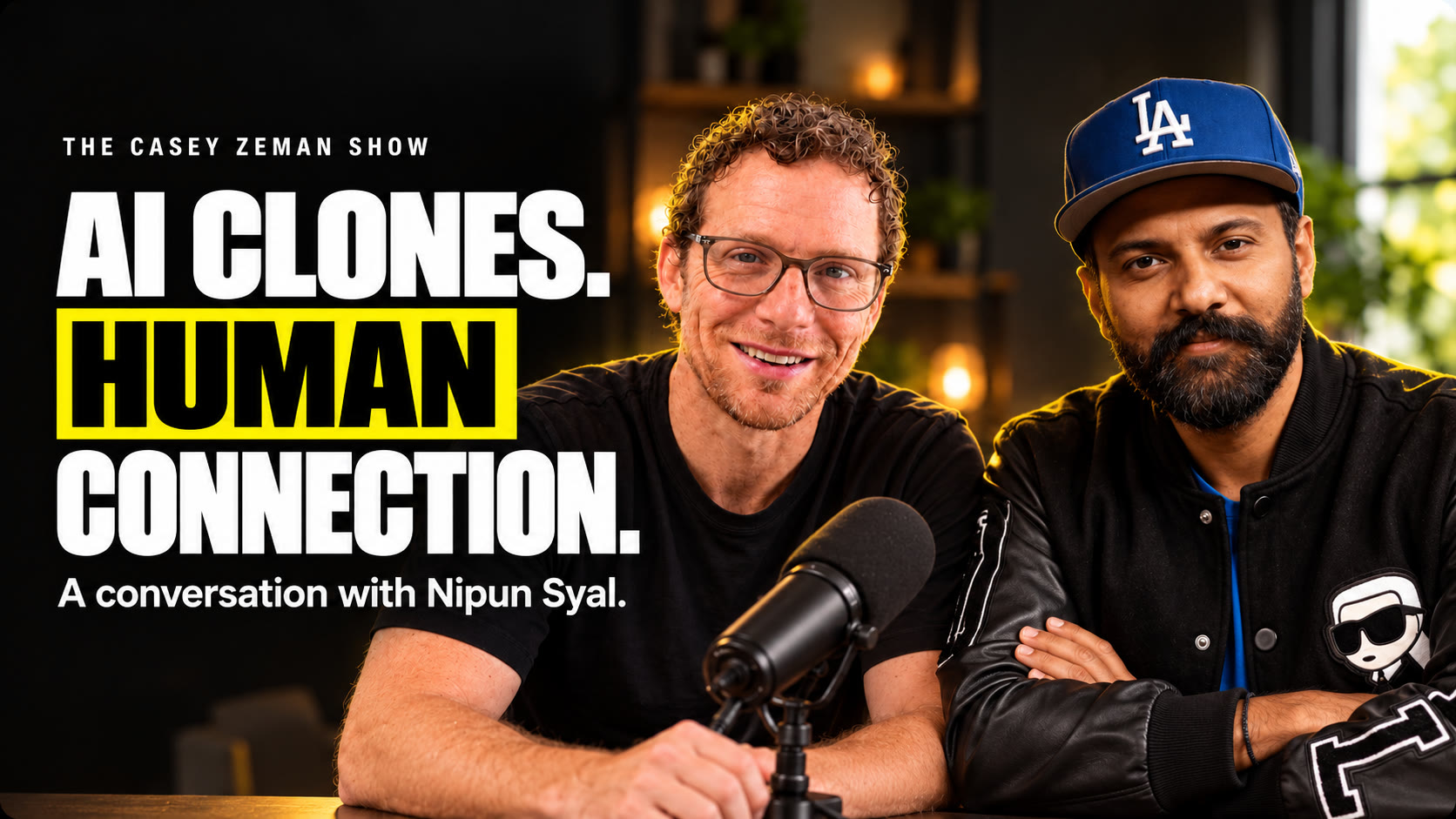
That question stayed with me after my conversation with Nipun Syal on The Casey Zeman Show. We talked about AI avatars, voice cloning, automated webinars, and the possibility of having content go out while the founder is somewhere else. But underneath the technology was a more interesting question: what are we trying to make room for?
A business can produce more content and still struggle to connect with people. A founder can save hours on recording and spend those same hours reviewing material that never sounds quite right. The tools create possibilities. Our decisions about how to use them determine whether those possibilities become something valuable.
Nipun brought both enthusiasm and practical experience to that conversation. He shared what he had tried, where the results disappointed him, and how his approach changed. Here are the ideas I think are worth taking beyond the interview and into your own business.
Before the automation, someone has to make the invitation
One of the stories that stood out had very little to do with AI. Nipun described reaching out to a GoHighLevel founder through Messenger with an invitation to appear on his podcast. There was no elaborate funnel behind that first conversation. He made the approach.
He also talked about putting himself in rooms with people he wanted to learn from, imagining himself on the stage, and continuing to pursue opportunities. Whatever you think about manifestation, there is a practical part of that story: he took action before he had the status he hoped to achieve.
It is easy to spend weeks preparing the system that will eventually help us approach someone. Sometimes the next useful step is a clear, relevant invitation. Why this person? Why this conversation? What would make it worth their time?
My takeaway is that relationships deserve the same intention we give our technology. Automation can support follow-through. It cannot decide for us which relationships matter or why we want to build them.
A convincing voice begins with how you actually speak
Nipun’s experience with voice cloning was especially revealing. He described reading a script to produce a voice sample, putting care into the process, and still getting a result that did not sound like him. His wife could hear the difference.
His approach shifted toward capturing a real conversation. When someone is answering a question, explaining an idea, or telling a story, their pace and emphasis change naturally. Those details can disappear when the same person tries to deliver every sentence perfectly from a script.
That is his experience, rather than a guarantee that one recording method will work for everyone. But it points to something useful even if you never create a voice clone: the material that sounds most like you may already exist in your conversations.
Think about a customer asking a question you hear all the time. You probably have a way of explaining the answer that is clearer and more natural than the first paragraph you would write for a polished presentation. You know where people get confused. You have an example ready. You can hear when the explanation needs to change.
For a founder building a content library, those moments are valuable source material. Record a thoughtful conversation, then look for the explanations, stories, and distinctions that actually help someone understand. Give your team that material to work with.
The tool is exciting. The routine is what makes it useful.
Nipun also described a pattern many teams will recognize: everyone gets excited about a new capability, content starts going out, and then the routine begins to slip. Having an avatar available does not automatically create a dependable publishing process.
There are still decisions to make. What is worth saying? Which part of a long conversation makes sense on its own? Who checks that an edit preserves the point? What happens when the captions get a name wrong or a clip promotes an event that has already passed?
Those are ordinary production decisions, but they matter. A polished video with the wrong name is still wrong. A short clip that removes the qualification from a statement can communicate something the speaker never intended. Faster production makes a clear review process more useful, not less.
My practical recommendation is to start with one complete path through the process. Take one interview, choose a few ideas that stand on their own, review the edits, and decide where each piece belongs. Give someone clear responsibility for the final check. Expand the volume once that process works.
That recommendation is my application of the conversation. You do not need to copy Nipun’s exact tools to use it. The goal is to build a routine your team can repeat even after the excitement of the new software wears off.
An automated webinar still has to earn the viewer’s time
When our conversation turned to EasyWebinar and automated presentations, Nipun came back to the value of the experience. If someone gives you their attention, are you helping them learn or make progress?
That is a useful standard because the audience experiences the presentation, not the production effort behind it. They do not benefit simply because we saved time. They benefit when the explanation is clear, the examples are relevant, and they can see what to do next.
Imagine a business owner watching a presentation about a problem they have been trying to solve for months. A helpful session might show them why their previous approach stalled, walk through a specific example, and help them decide whether a proposed solution fits their situation. Automating delivery can make that session easier to access. The substance still has to do the work.
Before automating a piece of content, I would ask three questions: What should someone understand afterward? What example will help them believe or evaluate the idea? What useful next step can they take? If those answers are vague, a more realistic avatar will not resolve them.
What happens when our avatars start talking to each other?
At one point, we explored the possibility of AI avatars carrying on conversations on our behalf. Nipun described seeing AI on both sides of an outreach exchange. It was a fascinating moment because it moved the discussion beyond creating videos and into how relationships might begin.
There are situations where exchanging information is exactly what we need. A system might help collect a question, organize details, or make it easier for someone to find a relevant resource. But when a person is uncertain, weighing a meaningful decision, or trying to explain something unusual, there may be much more happening than information exchange.
That is where I keep coming back to judgment. A founder needs to decide when a process can run reliably and when a real conversation will serve someone better. Efficiency is useful. So is noticing that the person in front of you needs something different from the usual answer.
This connects with an idea I explored in How I See My Industry Differently: scale the system and intensify the human. The opportunity is to use the time we recover deliberately—for better conversations, better teaching, and closer attention to the people we serve.
A small experiment worth trying
You do not have to redesign your business to put this into practice. Choose one recurring customer question. Record yourself answering it in a real conversation. Turn that answer into one useful piece of content, then review it for accuracy, clarity, and whether it still sounds like you.
After you share it, pay attention to the response. Did people understand the idea? What did they ask next? Which part needed another example? Those reactions can tell you what the next article or video should explore.
That is how I would build momentum: let a useful conversation lead to useful content, and let the response improve the next conversation. More output becomes worthwhile when it helps you understand your audience better.
The next question: what should you automate first?
Nipun’s story opens up an appealing possibility: a founder’s knowledge can reach more people without requiring another recording session for every piece of content. The harder decision comes afterward. Which parts of your work should become repeatable, and where does your personal involvement create the most value?
That is the next question I want to explore in this series: how to choose your first automation, give it a clear quality standard, and recognize when a human should step back in. Before then, consider your own week. Which repeated task consumes your time—and which conversation keeps getting postponed because of it?
Join my newsletter to follow the next articles on automation, webinars, and creating sales experiences that connect. You can also subscribe to The Casey Zeman Show for more conversations with entrepreneurs and business builders.
This article draws on my conversation with Nipun Syal and includes my own reflections and practical applications. The interview was recorded earlier; any event dates mentioned in the video refer to the time of recording.
Connect with Nipun Syal
Keep the conversation going: follow Nipun on LinkedIn and explore his AI Success Circle community for more on AI and business automation.