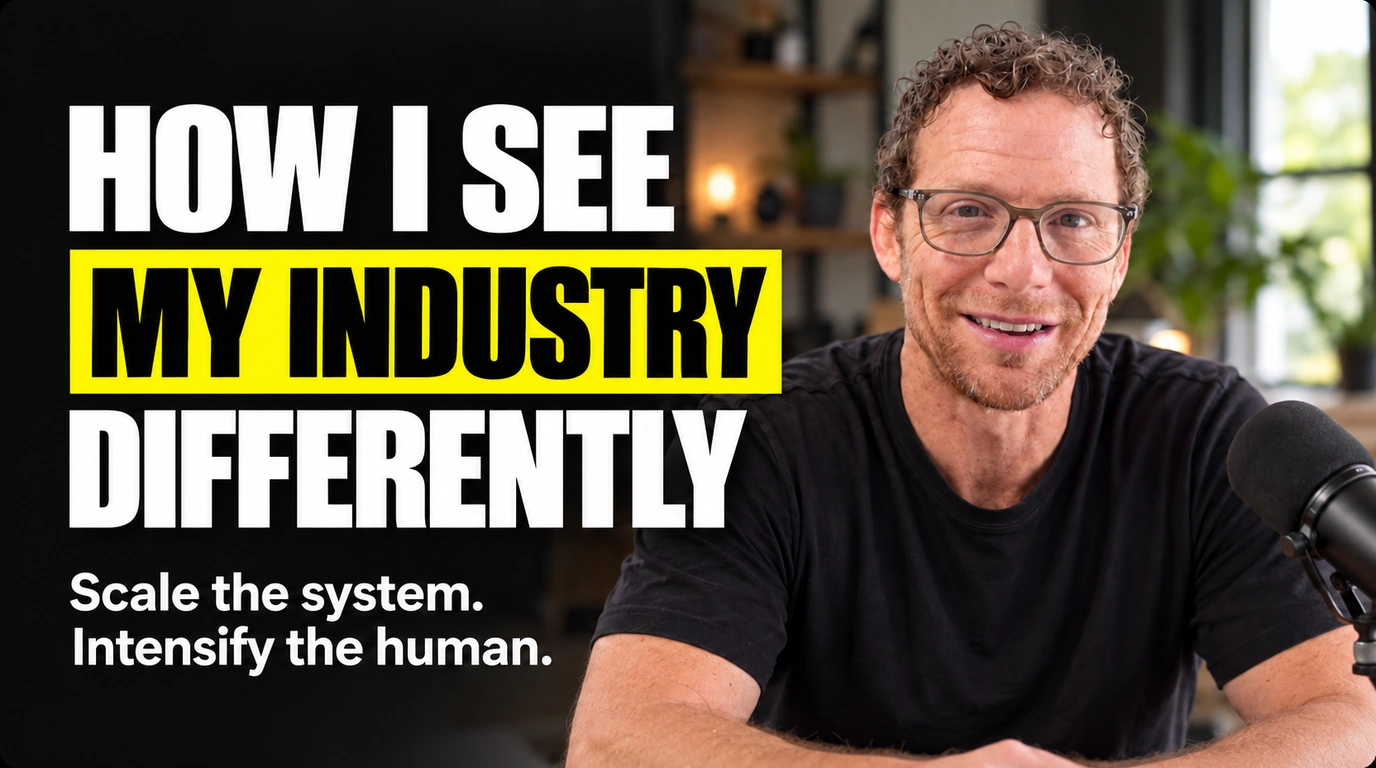
I think a lot of people in my industry are looking for the shortcut before they’ve earned the result.
They want the perfect script.
The perfect funnel.
The perfect AI prompt.
The perfect webinar template.
The perfect automation.
But that is not what creates a great webinar.
What creates a great webinar is mastery, reps, story, and human connection.
I think one of the biggest reasons experts struggle with webinars is that they are trying too hard to look polished and professional instead of being real.
They hide the parts of their story that actually make people connect with them.
I call those the broken glass moments.
Those moments where things were messy.
Where you were scared.
Where you were failing.
Where you weren’t sure it was going to work.
For me, that was a period where I was trying to build an online business while going into foreclosure and tremendous debt. I had insomnia. I was staying up until two or three in the morning, smoking cigarettes because I was so stressed, feeling heart palpitations, losing my hair, and wondering whether I was going to make any of it work.
Those are not the parts of your story most people want to expose.
Because they’re afraid it makes them look weak.
I believe the opposite.
Vulnerability is not weakness in marketing. It is evidence of the distance you have traveled.
That is what gives a story weight.
People need to see themselves inside your pain before they can believe you understand their transformation.
And too many experts are leaving that part out.
They are teaching information without revealing enough of the human experience behind it.
That is one of the biggest reasons their webinars do not resonate.
I do not believe in the perfect webinar script
Another thing I see completely differently is the obsession with finding the one perfect webinar script.
It does not exist.
There are frameworks.
There are structures.
There are best practices.
But the thing that creates conversion is not finding a magical script.
It is consistency.
You need reps.
You may need to run five webinars.
You may need to run 20.
You may need to run 50.
You have to get in front of real people, hear the questions, watch where they respond, feel where the energy drops, listen to the objections, change the story, refine the offer, and run it again.
Most people do not want to do that.
They want webinar number one to work.
And when it does not, they decide webinars do not work.
I think that is completely backwards.
A webinar is a skill.
And like every real skill, you earn it through repetition.
I think of it almost like a J-curve.
At first it feels like:
Failure.
Failure.
Failure.
Failure.
But you are collecting something every time.
Data.
Confidence.
Story.
Objections.
Audience language.
Timing.
Understanding.
And then at a certain point, all of that learning compounds.
Suddenly, something clicks.
And the curve goes up.
I’ve seen people completely transform their results simply because they were willing to put in more reps than everyone else.
One customer ran live webinars again and again over a concentrated period and went from essentially zero to hundreds of thousands in sales.
The lesson was not that he found some secret trick.
The lesson was that he stayed in the game long enough to get good.
Consistency becomes your greatest commodity.
People are also terrified of looking stupid
This is another big reason people do not do webinars.
They are afraid something will go wrong.
They are afraid they will forget what they were going to say.
They are afraid the technology will fail.
They are afraid someone will ask a question they cannot answer.
They are afraid their kids will walk into the room.
They are afraid they will look unprofessional.
And yes, all of those things can happen.
I’ve had webinar technology fail.
I’ve made mistakes live.
I’ve had my daughter come running into the room behind me when I was presenting.
Real life happens.
But here is what I have learned:
People are incredibly forgiving when you are authentic.
Sometimes the moments you are trying hardest to prevent are the moments that make the audience like you most.
Because now they see a person.
Not a perfectly manufactured presenter.
Not a polished avatar.
A human being.
And I think too many people are so afraid of looking stupid that they never put themselves in the position to become great.
You cannot become a master while protecting yourself from embarrassment.
My biggest disagreement with where the industry is going
I love AI.
I think AI is extraordinary.
I use it.
I believe everyone should learn how to use it.
But I think there is a real danger right now.
We can automate ourselves into complete sameness.
Everyone can write the same post.
Everyone can create the same hook.
Everyone can produce the same polished content.
Everyone can sound smart.
And if you are not careful, AI can actually remove the very thing that makes people want to work with you.
You.
So I believe in something like an 80/20 relationship.
Use AI for the 80%.
Use it for speed.
Research.
Organization.
Execution.
Ideas.
Analysis.
Systems.
But the other 20% has to be your mastery.
Your stories.
Your scars.
Your judgment.
Your point of view.
Your lived experience.
Your way of explaining the problem.
That is the part that cannot be commoditized.
And that 20% is often the thing that creates 80% of the connection.
If I had a megaphone to the whole industry
I would say:
Stop trying to automate the human out of your business.
Use technology.
Use AI.
Use webinars.
Use automation.
But use those things to create more connection, not less.
Tell the stories you are afraid to tell.
Expose the broken glass moments.
Let people understand what it actually felt like before you figured it out.
Stop looking for the perfect webinar script and start putting in the reps.
Run the webinar.
Get it wrong.
Run it again.
Listen to people.
Study the data.
Improve it.
Stop being terrified of looking stupid.
Something will go wrong.
Good.
That means you are doing it for real.
And stop trying to sound like everyone else.
Your advantage is not that you can produce more information.
AI can do that.
Your advantage is your mastery and humanity.
So if I had one message for the entire industry, it would be:
Use technology to scale the parts that are repeatable, but never outsource the parts that make you human.
Or even more simply:
Scale the system. Intensify the human.